

The OECD’s Corporate Residence Reform: Did It Get It Right?
16 July 2026
By Nicolas Traut (Oxford University Centre for Business Taxation) and Gustavo Weiss de Resende (New York University, Graduate Tax Center)
Determining where a company is resident is fundamental to the allocation of taxing rights under tax treaties. When a company is treated as a resident of two countries simultaneously, a tie-breaker rule must resolve the conflict. For decades, Article 4(3) of the OECD Model Tax Convention determined residence by reference to the Place of Effective Management (PoEM), that is, the place where key management and commercial decisions are substantively made. In 2017, however, the OECD replaced PoEM with a Mutual Agreement Procedure (MAP) as the default corporate tiebreaker.
Under the new approach, instead of applying a concrete rule, the competent authorities of the contracting states must determine a company’s treaty residence by mutual agreement on a case-by-case basis. Until they reach – and even if they fail to reach – an agreement, the company is generally denied treaty benefits. The reform was driven by concerns that the PoEM tiebreaker had become increasingly difficult to apply in the context of modern business models and by the assumption, which can be traced back to the BEPS Action 6 Final Report, that dual residence was “often” artificially engineered for tax avoidance. By removing automatic access to treaty benefits, the OECD sought to deter abusive arrangements.
Whether this shift has achieved its objectives is, however, open to question. Both its practical consequences and its normative justification warrant closer scrutiny, particularly in light of the treaty practice that has emerged since the 2017 reform.
Empirical findings on treaty practice
How have treaty negotiators responded to the OECD’s reform? An analysis of 267 tax treaties signed between 1 January 2018 and 31 December 2024, together with 17 relevant protocols, reveals a clear trend, albeit with significant variation across jurisdictions. Overall, around 56% of new treaties adopted the MAP as the sole corporate tiebreaker. Among treaties concluded between two OECD member states, this figure rises to around 69%, reflecting strong alignment with the revised OECD Model. Yet the PoEM criterion remains remarkably resilient, appearing in about 28% of all new treaties and about 27% of treaties concluded between two OECD members.
The EU stands out in this respect. Among treaties concluded between two EU Member States, only one-third adopted the MAP, while two-thirds relied on PoEM. For a bloc that has consistently championed the OECD’s anti-avoidance agenda and frequently translated OECD initiatives into EU law, this represents a notable departure from the OECD’s preferred approach. It suggests that even jurisdictions with sophisticated tax administrations and close institutional ties to the OECD may not regard the MAP as the preferable solution for resolving dual corporate residence.
Figure 1: Tiebreaker implementation, 2018-2024, percentages
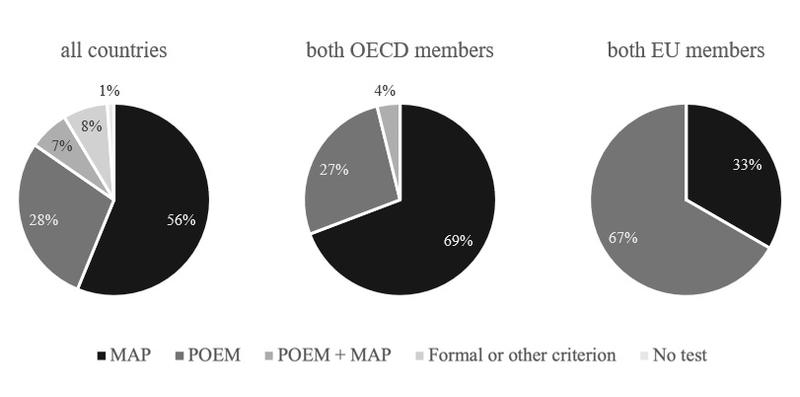
The data also reveal a gradual consolidation of the MAP over time: whereas only around 36% of new treaties adopted the MAP in 2018, the figure had risen to around 71% in 2024. Yet the continued use of PoEM and other alternatives in a substantial minority of treaties demonstrates that the OECD’s preferred approach has not achieved universal acceptance.
Figure 2: Tiebreaker implementation, 2018-2024, number of treaties

Normative assessment of the MAP tiebreaker
While the data point to a shift towards the MAP, the normative case for the reform is less clear. First, procedural fairness suffers. Under the MAP tiebreaker, taxpayers are reduced to passive observers while two governments negotiate their fiscal status. There are no clear timelines, no clarity as to whether taxpayers have access to arbitration, and no obligation to explain the outcome. If the competent authorities fail to agree, treaty benefits are generally denied. By contrast, the PoEM test, despite its imperfections, provides a fact-based rule that offers taxpayers greater legal certainty.
Second, the MAP places considerable demands on tax administrations. Resolving treaty residence through bilateral negotiation requires experience, resources, and administrative capacity. Yet our data show that several jurisdictions with little or no prior MAP experience have nevertheless adopted the new tiebreaker. The result may be delays, procedural bottlenecks, and imbalances in negotiating power.
Third, the anti-avoidance rationale is unpersuasive. The reform assumes that dual-resident companies are vehicles for treaty abuse. In practice, however, dual residence can result from legitimate commercial activity, such as cross-border mergers, regulatory requirements, or differences in domestic residence rules. By denying treaty benefits unless the competent authorities reach an agreement, the MAP fails to distinguish between legitimate and abusive arrangements, imposing procedural burdens and legal uncertainty on bona fide taxpayers. Existing anti-avoidance rules, such as the principal purpose test, are better suited to address treaty abuse.
The hybrid approach and directions for reform
Rather than treating PoEM and the MAP as mutually exclusive alternatives, a more balanced solution would combine their respective strengths. Under a hybrid approach, PoEM would remain the primary tiebreaker, providing a clear, fact-based determination in most cases, while the MAP would serve as a fallback where PoEM is genuinely inconclusive. This preserves the legal certainty of PoEM while retaining the MAP’s flexibility for exceptional cases and avoids the current all-or-nothing approach, under which treaty benefits are denied unless the competent authorities reach agreement. This approach also reflects existing treaty practice, with PoEM continuing to appear in a substantial minority of post-2017 treaties. Despite these advantages, the hybrid approach remains uncommon: only around 7% of treaties concluded between 2018 and 2024 adopted it. One reason may be that it is neither included in the OECD Model nor expressly acknowledged in the Commentary. Given the OECD’s influence on treaty practice, the OECD should recognise the hybrid approach, thereby encouraging wider adoption of a solution that better reconciles legal certainty, procedural fairness, and administrative flexibility.
The empirical evidence and normative analysis point to two further reforms. First, MAP proceedings should become more transparent. Anonymised data on MAP cases involving dual-resident companies, including timelines, outcomes, and reasoning, should be published to strengthen accountability and enable taxpayers and practitioners to better understand how the mechanism operates in practice. Second, the OECD Commentary should provide more detailed procedural guidance on corporate residence MAP negotiations and clarify that taxpayers have access to arbitration where the competent authorities fail to reach agreement within a reasonable period.
This blog is based on the authors’ chapter, “State Practice on Corporate Tiebreakers: Procedural Fairness, Ease of Administration and Robustness to Avoidance”, in West and Messina (eds), Taxing Corporates: 2025 and Beyond, IBFD 2026, which presents a more comprehensive empirical and normative analysis and full references.

