

Does automatic information exchange work in developing countries?
24 June 2026
By Niels Johannesen (Oxford University Centre for Business Taxation), Nadine Riedel (University of Münster), Lauge Larsen (Danish Ministry of Taxation)
In a coordinated effort to improve financial transparency, more than 100 governments now exchange information about bank accounts with cross-border ownership. The policy requires banks to identify all accounts beneficially owned by foreigners and share details about account balances and income flows with the account owner's home tax authority.
The motivation underlying the policy is clear: financial secrecy in offshore centres has historically made it difficult for tax authorities to verify whether income earned abroad is properly declared at home. Automatic information exchange addresses this challenge by giving tax authorities the ability to cross-check taxpayer declarations of foreign financial income against information reports from third parties, which is known to be a powerful enforcement technology in the domestic context (Kleven et al. 2011).
Despite the conceptual merits of automatic information exchange, the policy has met considerable scepticism in developing countries. The key concern is that tax administrations with scarce resources may lack the capacity to make effective use of incoming information reports. Tellingly, only around one third of middle-income countries and no low-income countries have chosen to participate in the policy (Johannesen, 2024).
In a new research paper, we put this scepticism to the test (Johannesen et al, 2026). In the context of South Africa, we use rich administrative data to analyse the compliance effects of automatic information exchange and investigate the mechanisms underlying these behavioural responses.
How much offshore wealth do South Africa have?
We analyse account-level information reports about more than 1 million accounts held by South Africans in foreign banks. We combine this dataset with granular information from tax returns and case-level audit data.
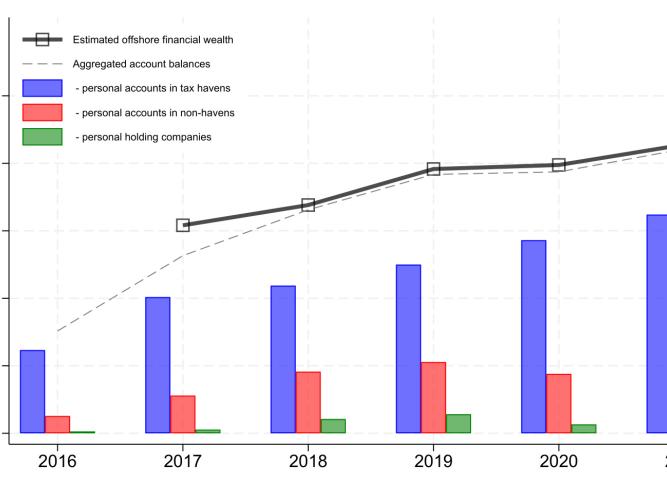
As illustrated in Figure 1, the information reports received from foreign banks imply that South African households hold around $80-85 billion of offshore financial wealth. Around three-quarters of this wealth sits in jurisdictions like Switzerland, Luxembourg, and Singapore that until recently maintained strict banking secrecy. The offshore wealth is equivalent to around 20% of GDP, which is almost twice as large as previous estimates based on macro sources (Alstadsæter et al., 2018) and consistent with global estimates of offshore household wealth in the trillions of dollars (Zucman, 2013; Johannesen et al., 2024).
Figure 1: Offshore financial wealth owned by South Africa
We document that South African offshore wealth is heavily concentrated among the rich: roughly 20% of the wealth sitting in foreign accounts belong to the 15,000 taxpayers in the top 0.1% of the income distribution. These results are consistent with evidence from other countries (Alstadsæter et al., 2019; Londoño-Vélez and Tortarolo, 2022; Boas et al., 2024) and with potentially important distributional implications of tax enforcement in the offshore domain (Johannesen, 2023).
Did automatic information exchange improve tax compliance?
Our analysis of information reports and tax returns suggests that automatic information has made South African taxpayers with foreign financial income notably more, but still far from fully, tax compliant.
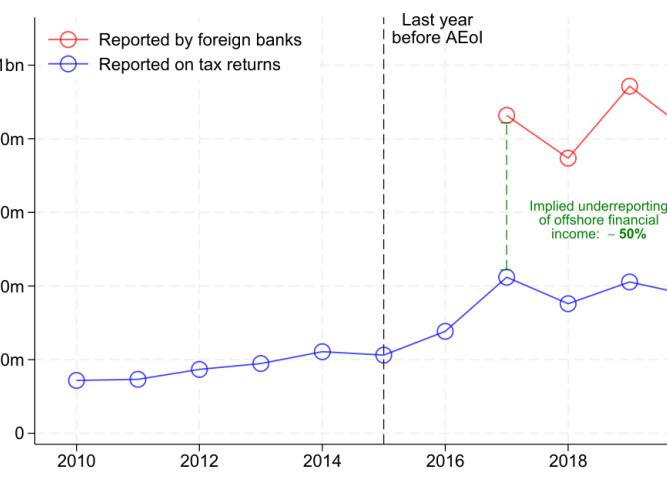
As shown in Figure 2, aggregate foreign financial income self-reported by South African taxpayers was roughly flat at around $200 million per year. Around 2016-2017, coinciding with the first waves of automatic information exchange, this aggregate increased sharply to around $400 million and remained at this higher level. This is suggestive of a real and persistent compliance response.
However, Figure 2 also shows that bank-reported foreign financial income was running at roughly $800 million over the post-reform period. Hence, even after the onset of automatic information exchange and the associated improvement in tax compliance, South Africans were reporting only around half of their foreign financial income.
Figure 2: Aggregate self-reported versus bank-reported foreign financial income
Exploiting the granularity of the micro-data, we show that the increase in self-reporting was concentrated among owners of the largest foreign accounts. For illustration, the number of taxpayers reporting more than $100,000 in foreign financial income nearly tripled between 2015 and 2017, while the number reporting smaller amounts barely changed.
Why did so many taxpayers keep evading?
From the vantage point of theory, it is puzzling that many taxpayers continued to underreport offshore financial income. Automatic information exchange makes it straightforward for tax authorities to detect underreporting: it only requires a cross-check of bank-reported and self-reported income. By performing such cross-checks systematically, the tax administration could raise the detection probability to almost one and deter rational taxpayers from underreporting (Allingham and Sandmo, 1972).
To shed light on the puzzle, we estimate the detection risk faced by taxpayers with non-compliant foreign financial income. Exploiting the audit data, we compare taxpayers with foreign financial income who are similar in terms of background risk (e.g. income, age, self-employment) and in terms of true foreign financial income (amount and bank country) but who differ with respect to self-reporting. As shown in Figure 3, not self-reporting foreign financial income is associated with a small excess risk of audit correction of around 1 percentage point, relative to a baseline audit correction rate of around 10%. The figure also shows that the excess risk is somewhat higher for taxpayers with accounts in tax havens and much higher for taxpayers with large amounts of foreign financial income.
Figure 3: The probability of audit correction
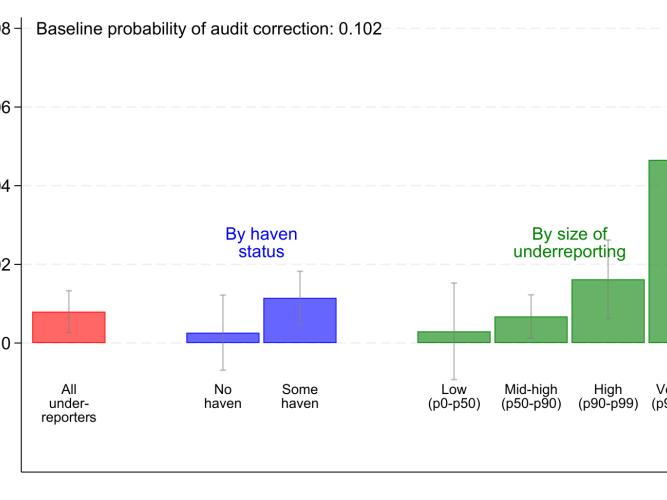
These results go a long way toward rationalizing the observed taxpayer compliance behaviour. When non-reporting is associated with a relatively small detection risk - presumably because tax authorities do not systematically cross-check self-reported and bank-reported income - many taxpayers choose to remain non-compliant. When the detection risk is somewhat larger - e.g. like we find at the top of the distribution of foreign income - more taxpayers choose to become compliant.
What this means for policy
Our paper contributes to a literature that assesses policy interventions to rein in offshore tax evasion. One strand studies compliance effects of automatic information exchange in developed countries: Norway (Alstadsæter et al., 2024), Denmark (Boas et al., 2024), Switzerland (Baselgia, 2026) and France (Davoine et al., 2026). Another strand studies alternatives policies: tax amnesties (Johannesen et al., 2020; Londoño-Vélez and Tortarolo, 2022), information exchange on request (Johannesen and Zucman, 2014); withholding taxes in tax havens (Johannesen, 2014; Roussille and Martinez-Toledano, 2024) and government purchases of leaked data (Johannesen and Stolper, 2021).
The key policy implication of our analysis is that automatic information exchange can have economically significant compliance effects in developing countries, even with an audit effort that focuses on the largest foreign bank accounts and tolerates widespread non-compliance for smaller accounts. This is relevant for the large number of low- and middle-income countries that have currently opted out of automatic information exchange and may be considering whether to participate in related areas of policy cooperation, such as exchange of information on crypto investment.
References:
Allingham, M. G., and Sandmo, A. (1972). Income tax evasion: A theoretical analysis. Journal of Public Economics, 1(3-4), 323-338.
Alstadsæter, A., Johannesen, N., and Zucman, G. (2018). Who owns the wealth in tax havens? Macro evidence and implications for global inequality. Journal of Public Economics, 162, 89-100.
Alstadsæter, A., Johannesen, N., and Zucman, G. (2019). Tax evasion and inequality. American Economic Review, 109(6), 2073-2103.
Alstadsæter, Annette, Casi, E., Miethe, J., Stage, B. (2024). Lost in Information: National Implementation of Global Tax Agreements. Skatteforsk working paper #10.
Baselgia, E. (2026). The compliance effects of the automatic exchange of information: Evidence from the Swiss tax amnesty. Journal of Public Economics. 105653
Boas, H.F., Johannesen, N., Kreiner, C.T., Larsen, L.T. and Zucman, G. (2024). Taxing Capital in a Globalized World: The Effects of Automatic Information Exchange. NBER Working Paper 32714.
Davoine, E., Herry, S. L. G., Le Pouhaer, E., and Leenders, W. (2026). Global Transparency and Tax Enforcement on Foreign Capital. Working paper
Guyton, J., Langetieg, P., Reck, D., Risch, M., and Zucman, G. (2021). Tax evasion at the top of the income distribution: Theory and evidence. NBER Working Paper 28542.
Johannesen, N. (2014). Tax evasion and Swiss bank deposits. Journal of Public Economics, 111, 46-62
Johannesen, N., and Zucman, G. (2014). The end of bank secrecy? An evaluation of the G20 tax haven crackdown. American Economic Journal: Economic Policy, 6(1), 65-91.
Johannesen, N., Langetieg, P., Reck, D., Risch, M., and Slemrod, J. (2020). Taxing hidden wealth: The consequences of us enforcement initiatives on evasive foreign accounts. American Economic Journal: Economic Policy, 12(3), 312-346.
Johannesen, N., & Stolper, T. B. (2021). The deterrence effect of whistleblowing. The Journal of Law and Economics, 64(4), 821-855.
Johannesen, N., Reck, D., Risch, M., Slemrod, J., Guyton, J., and Langetieg, P. (2024). The Offshore World According to FATCA: New Evidence on the Foreign Wealth of US Households. Tax Policy and the Economy, 38(1), 61-99.
Johannesen, N. (2023). The end of bank secrecy: implications for redistribution and optimal taxation. Oxford Review of Economic Policy 39(3), p. 565-574.
Johannesen, N. (2024). Offshore tax evasion in developing countries: Evidence and policy discussion. WIDER Working Paper 2024/15.
Johannesen, N., Larsen, L., and Riedel, N. (2026). Does global financial transparency improve tax compliance in developing countries? CEPR Working Paper 21642.
Kleven H. J., Knudsen, M. B., Kreiner, C. T., Pedersen, S., and Saez, E. (2011). Unwilling or unable to cheat? Evidence from a tax audit experiment in Denmark. Econometrica, 79(3), 651-692.
Londono-Velez, J., and Tortarolo, D. (2022). Revealing 21 per cent of GDP in hidden assets: Evidence from Argentina's tax amnesties. UNU-WIDER Working Paper 2022-103.
Roussille, N., and Martinez-Toledano, C. (2024). Tax evasion and the "Swiss cheese" regulation. Working paper available at SSRN 4735860.
Zucman, G. (2013). The missing wealth of nations: Are Europe and the US net debtors or net creditors? Quarterly Journal of Economics, 128(3), 1321-1364.